Simulation: Simio, Arena, AnyLogic
Years of professional simulation experience

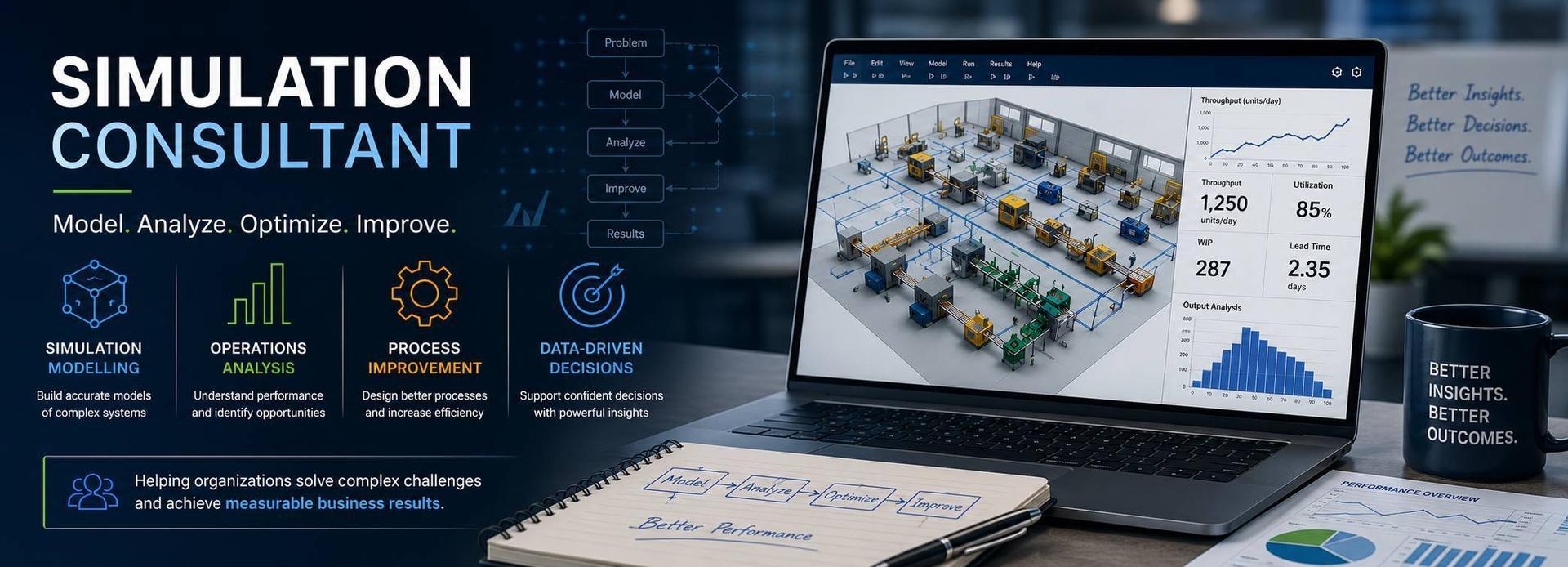

Francois has over thirty years of experience in discrete event simulation, providing consulting, training, and technical support services. He helps organizations gain deeper insight into their operations by developing simulation models that accurately represent business processes and eliminate uncertainty in decision-making. Through rigorous analysis of key performance drivers, he delivers data-driven insights that support sound strategic and operational decisions.
He has led successful projects across South Africa, West Africa, the United States, and the Middle East, covering warehouse and supply chain logistics, manufacturing, facility planning, mining logistics, airline passenger transportation, and business process analysis.
His clients include SASOL, Emirates Airline, Saudi Aramco, Anglo American, Harmony Gold Mining Company, Petra Diamonds, Standard Bank, Capitec Bank, Promasidor (Nigeria), Ceres Fruit Processors, and Pella Corporation (USA).
In addition to consulting, Francois lectured simulation part-time to Industrial Engineering students and served as an external examiner at several South African universities. He has also presented simulation workshops and conference talks throughout his career.
Years of professional simulation experience
Simulation: Simio, Arena, AnyLogic
General: MS Word, Excel, Powerpoint, Power BI
Specializing in simulation consulting with Simio, AnyLogic, and Arena. I provide expert training, comprehensive technical support, and Simio simulation software solutions.
Responsible for simulation business and obtaining new clients.
Official South African representative for Arena (by Rockwell Automation) and Simio (by Simio LLC). Providing software solutions, professional training, technical support, and expert consulting services.
Subject matter expert
Integrity and honesty
Client engagement
Process improvement
Analytical thinking
Business Process Analysis
Attention to detail
Analysis & evaluation
Process optimization
Simulation Specialist
Determine the number of required briefing/debriefing rooms in new operations building to ensure timeous movement of crew by using a simulation model representing crew movement and constraints.
(Capacity Planning - Middle East Airline)
___________________________________________________________________________
Evaluate various bus types and fleet sizes to ensure passengers are on time for departing aircraft and buses are on time to collect arriving passengers.
(Logistics - Airports Company of South Africa)
___________________________________________________________________________
Modelled warehouse inbound and outbound operations to identify bottlenecks and balance demand. Tested removal of two key constraints — bin reservation and client truck arrival times — improving Put Away and Picking tasks by 52% and 45%, respectively.
(Warehouse - Major South African FMCG Group)
___________________________________________________________________________
Optimized plant-to-customer transport policies for a major U.S. window and door manufacturer, increasing trailer utilization by 25%.
(Supply Chain Logistics - USA Manufacturer)
___________________________________________________________________________
Build simulation model for petroleum company to assist in ways to reduce time in plant for trucks, determine loading/offloading bays required and determine safety levels of product storage tanks.
(Logistics - Middle East Oil & Gas Company)
___________________________________________________________________________
Simulate outbound logistics for GTL plant. Investigate loading from final product tanks into road and rail tankers to determine sufficient tank sizes, required number of road and rail tankers and required number of rail loading bays.
(Supply Chain - Canadian Oil & Gas Company)
___________________________________________________________________________
Used Simulation to determine best transportation and loading/offloading options to reduce gate-to-gate time on premises and increase throughput. By changing the traffic flow alone, throughput could be increased by 17% — equivalent to six additional trucks/day — at no additional cost.
(Capacity Planning - Major Nigerian FMCG Producer)
___________________________________________________________________________
Model steady state production for block cave and sub-level cave to determine LHD fleet size and if planned throughput could be achieved. Mine used model for ongoing planning.
Capacity Planning - SA Diamond Mine)
___________________________________________________________________________
Simulate underground mine workshop to determine number of work bays required. Prevent 79% productivity loss (due to waiting time) by adding a repair bay.
(Capacity Planning - Southern African Diamond Mine)
___________________________________________________________________________
Evaluated dam sizes and pumping strategies in a gold mine’s water reticulation system to reduce pumping cycles and electricity costs.
(Water Balance - AngloGold Ashanti, South Africa)
Discrete Event Simulation (DES) is a modelling technique used to represent and analyze systems. Specialized simulation services are typically provided by simulation Subject Matter Experts (SMEs).
Organizations frequently face strategic and tactical decisions that ultimately have financial implications. When evaluating such decisions, they often engage simulation SMEs to develop a model of the relevant business processes. This model represents the specific part of the organization under investigation—such as assessing the impact of a factory expansion on throughput, or a new marketing campaign on resource allocation.
Usually starting at the current (As-Is) scenario, the simulation model is then used to explore multiple “what-if” (To-Be) scenarios, effectively enabling the organization to test potential future outcomes in a risk-free environment. The objective is to provide senior management with robust, scientifically grounded decision-support insights.
To deliver these insights, simulation SMEs must carefully interpret and analyze the results generated by the model. This requires rigorous and often extensive data analysis to ensure that conclusions are accurate, meaningful, and actionable. E.g. queue lengths, time spent in queues and resource (constraint) utilization are considered to identify bottlenecks.
Discrete event simulation is particularly effective for:
· Greenfield Projects: Model new facilities, processes, or systems
· Brownfield Analysis: Analyze modifications to existing operations
· Variability Management: Understand and mitigate the impact of variability
· Resource Optimization: Optimize resource allocation and system configurations
· Performance Enhancement: Improve overall system performance and efficiency